
The market experts in VOLUE Data & Forecasting have been performing scenarios for Continental Europe and Japan to assess the impact of gas prices on the power markets till the end of 2028, playing out with extreme fuel assumptions. We summarize the main takeaways from our analysis in this document.
Gas
The closing of the Hormuz Strait has cut off around 20% of the world's liquified natural gas (LNG) supplies, notably from Qatar. Most of this normally ends up in Asia, and Europe's direct reliance on Qatari supply is limited - accounting for only 7% of total LNG imports. But Europe and Asia will be impacted in a similar way as Asia, in its effort to replace Qatar, will pull cargoes from othe sources, like the US and Africa, away from Europe. In fact, we're already seeing cargoes being diverted from Europe towards Asia.
The crucial factor is the duration of the blockage. Qatar has declared force majeure on its giant LNG production facility at Ras Laffan. It may take 2 weeks to restart, followed by time to ramp up to full capacity. This likely means a month long disruption is in the cards, and probably more. But few expect the situation to last more than three to six months, and in that sense, it is not comparable to the loss of Russian gas during the energy crisis, even though we are talking similar volumes per day.
Gas futures for the entire year are impacted. Gas storage in Europe are at the lowest level in four years, and tougher competition for LNG will make it harder to refill storages ahead of next winter.
Alpine hydropower
Hydro reservoir levels are currently below normal across most of the Alpine region, with the main exception being France, where heavy inflows in February temporarily lifted reservoir levels slightly above seasonal norms. Hydropower production has remained elevated in Switzerland in recent months, but this pace is unlikely to be sustained as reservoir levels there are already relatively low. Austria and Northern Italy face similar constraints due to limited reservoir levels, while France is currently in a stronger position following the large inflow event earlier this year. At the same time, Alpine snowpack is below normal across the broader region and lower than last year, which may limit inflow potential in the coming months. Overall, this suggests a lower contribution from hydropower compared to last year. However, the outlook remains sensitive to precipitation levels later in the year.
Power
To assess the impact on power markets, we ran 2 scenarios with our inhouse fundamental model: the 1st one (called High) includes a 100% premium on gas and oil, and a 50% premium on coal prices, the 2nd scenario (Extreme) includes a 200% premium on gas and oil and a 100% premium on coal prices.
We compared the two runs with the EEX future closings for each market on the 27th of February, shortly before the attack to Iran (Pre-crisis) and the closings of the 6th of March (Reference).
Focus on Japan
Japan’s direct exposure to Qatari LNG is moderate but non-negligible. Out of roughly 80 million tons per annum of LNG production in Qatar, Japan currently procures 3.4 million tons, equivalent to around 5% of total Japanese LNG imports. Procurement is concentrated among major utilities, JERA (0.7mt), KEPCO (0.5mt), and TEPCO and Tohoku Electric (0.18 mt each), highlighting system relevance despite limited aggregate volume. JERA’s newly signed contract for an additional 3 million ton per annum from 2028 underscores the strategic importance of Qatari supply over the longer term.
In response to the force majeure declaration, utilities have emphasized portfolio flexibility rather than immediate disruption. This suggests that near-term operational risk is contained, but price exposure remains highly asymmetric to the upside.
Our scenario analysis illustrates this clearly. Under 2x and 3x gas price shocks, simulated power prices in Tokyo, Kansai, and Chübu rise well above current EEX forward prices, indicating that the market is not yet fully pricing extreme fuel-disruption outcomes. The divergence is most pronounced in gas-heavy regions, reflecting Japan’s structural reliance on LNG-fired marginal generation.


Focus on Europe
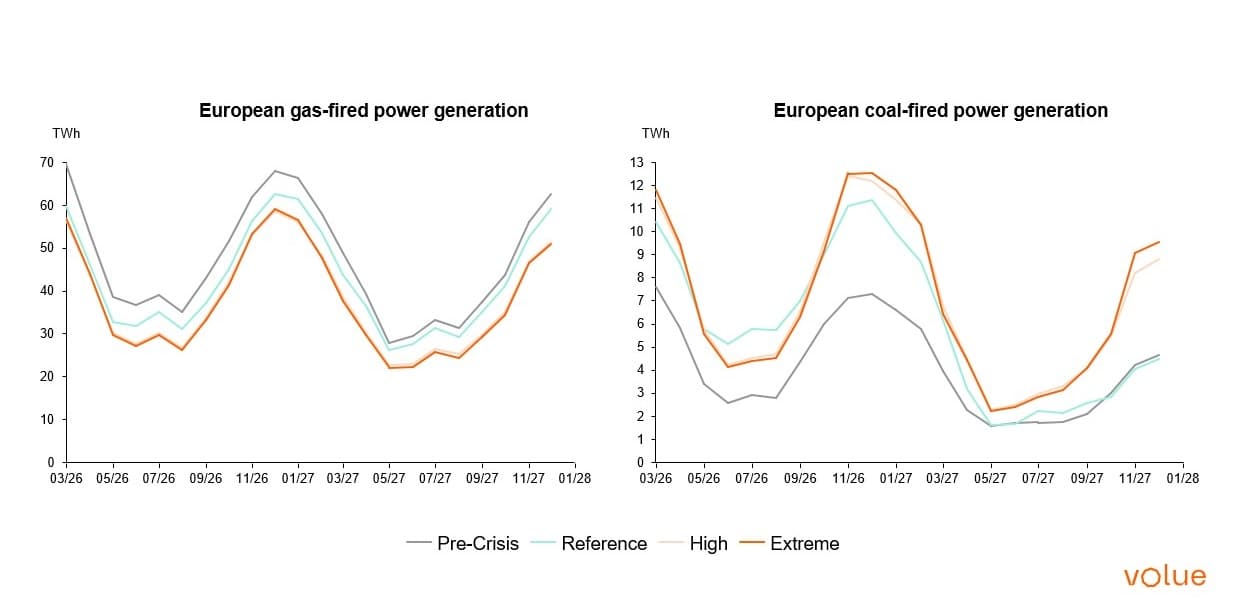
Looking at Continental Europe, we see a main shift in power balance with the scenarios High and Extreme pointing to a significant drop in gas-fired generation, compensated by coal and lignite production, mainly in Germany and Poland.
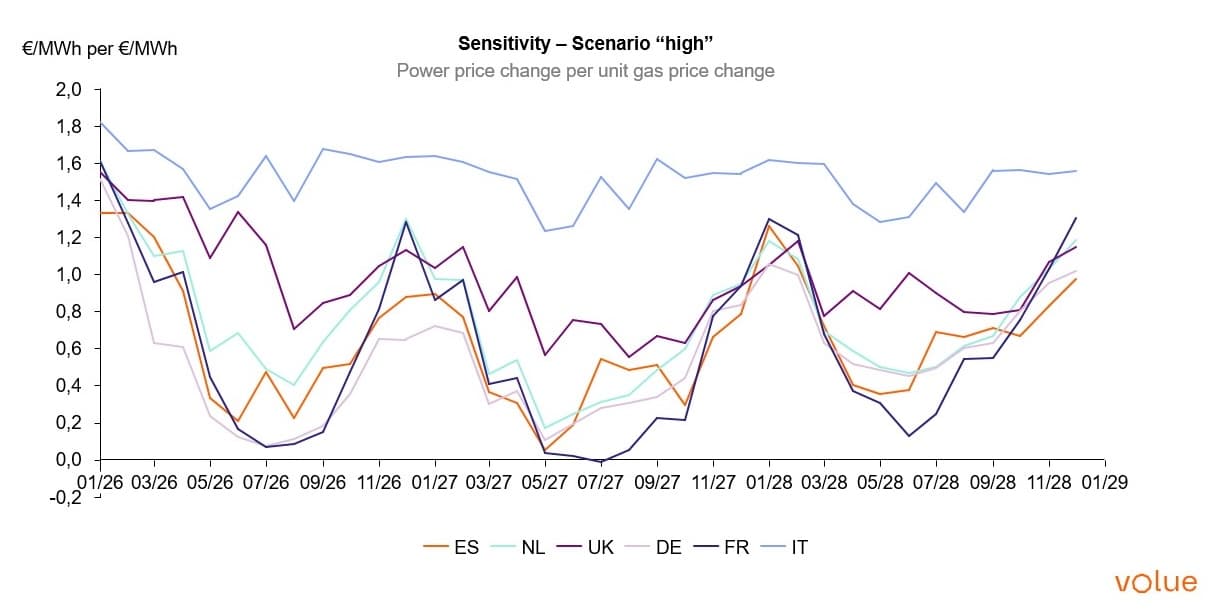
In terms of power prices we observe a larger impact from extreme gas on those strongly CCGTs dominated countries such as Italy and UK, where gas Short Run Marginal Cost sets the power prices in most of the hours. An easy way to gauge the impact on power prices, is to look at the sensitivity of power prices for every unit change in input gas prices. It allows us to understand the instantaneous impact of gas prices movements on power prices between the gas price levels chosen for this analysis.

Germany
Germany shows a sensitivity of 0.5-0.7 (EUR/MWh Power price change per EUR/MWh gas price change) in winter while dropping to about 0.1-0.2 in summer. This sharp difference is explained by the difference in power balance between winter and summer as the number of hours fossil fuels sets the price in summer is significantly lower.
In terms of absolute power prices, we see the same sensitivity translate into a higher price ceiling for the winter while a below market expectation for the summer. Indicating the bullish sentiment for the summer contracts might be overstated at the moment.

The higher gas price scenario leads to a reduction in UK gas-fired output of only 15-20% this year compared with our base case, due to the limited possibility of substituting with other fuel types, given that gas remains the key source of power system flexibility.
Lower domestic gas burn is met by higher net power imports, which rise by an average 1.2 GW this year, and 1.5 GW in 2027, relative to the base. Particularly, imports from France and Norway are stronger, given that these markets are less dependent on gas in their respective power mixes.
The extreme scenario in the near term is almost identical to the high gas price scenario, suggesting that the UK will soon exhaust all options for alternative domestic supply or imports to meet demand. Interconnector flows are also constrained, given that we increased gas prices across Europe in the higher price scenario, the supply tightness is felt everywhere.
The price impact is strong, with our UK power forecast jumping an average 51% compared to our base for the April-December period. Altogether, a continued bullish course in the gas market threatens to pull up UK prices further than what we currently see traded.

Italy and Spain
Italy is the country with the highest share of Qatari imports in Europe.
It is by far the market most affected by the simulation on extreme gas prices, with a rather flat curve across the seasons and an increase by 60% for Q2-2026 in the first scenario and by 118% in the most extreme one.

CCGTs output fall by about 9% and 10%, respectively in High and Extreme scenarios. The drop in thermal output is mainly compensated by higher imports from France over Q4-2026 and Q1-2027 of about 10%.

Iberia shows limited reduction in gas fired generation even in the extreme scenario and an impact in power prices mainly pronounced in the winter quarters.

